22 August 2026 · 8 min read
A Simple Godley Model Using Czech Data: Which Sector Drives GDP?
Using the fiscal and trade ratios from Wynne Godley’s iconic 1999 paper, I run them on Czech data. The results give some food for thought.
The British Coventry Cathedral has a remarkable statue on its east wall. Saint Michael, to whom the cathedral is dedicated, is celebrating his victory over the devil. Jacob Epstein, the famous sculptor who created the work, had a beautiful daughter, Kathleen, who was married twice. Her first husband was the artist Lucian Freud, and second was the economist Wynne Godley. Epstein thought Godley was “incredibly handsome” and immortalised his face in the statue as the angel.

We probably won’t find many economists to whom statues or bohemian admiration are dedicated, but the immortalised Wynne became famous later, between 1999 and 2007. He devoted his life to sectoral analysis (see his magnum opus, Macroeconomics, 1983, co-written with Francis Cripps), and in 1999 he wrote a report (Godley, 1999) in which, based on a formal accounting model, he predicted the steep growth of private debt in the United States and the risk of a major financial crisis.
Let’s apply his model to Czech data. What will it tell us?
I. Godley’s Model.
Like any honest heterodox economist, Wynne pictured the economy as a system of flows and stocks (in the tradition of the classics, see Copeland, 1952; Backus et al., 1980; Leontief, 1966). The income of one sector is the expenditure of another. If someone spends more, someone must spend less. He extended the GDP identity with the flows as follows:
Where \(S\) is income, \(I\) is expenditure, \(p\) of the private sector (households and firms), \(g\) of the government, and \(\mathit{CAB}\) is the current account, \(X - M\). If the budget is in the red, and the external account is in the green, the private sector “saves”, its net financial position increases. If the private sector’s debt increases, then net financial assets are leaking somewhere, either the government collects more in taxes than it spends, or we sell less to the world than we buy from the world.1
Godley’s flow logic is hard to refute, if we consider a simple accounting sequence. Czech government is probably the last entity to suspect of any high stylistic vibes, but let’s assume it has decided to buy fancy Italian furniture from the domestic supplier worth 500 000 CZK, and that’s the only expense it had. On top of that, it collected taxes from the private sector exceeding the purchase amount, say in an amount of 600 000 CZK (so taxes exceeded spending in a given period). For the simplicity, we do not consider VAT, only the income tax, and only final balance sheet implications free of cost and revenue other than taxes. Then we would have:
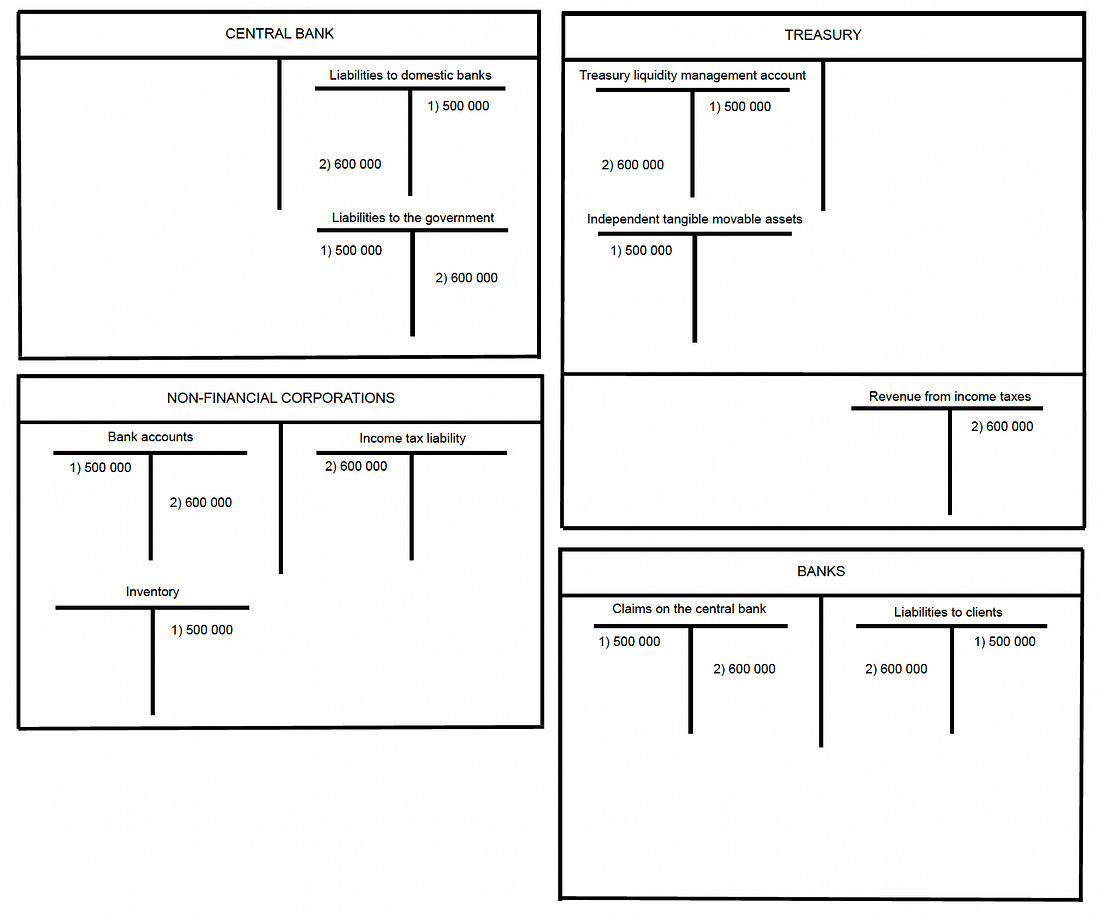
Government is now in surplus of 100 000 CZK, while the private sector’s net financial position went down by 100 000 CZK. Correspondingly, M3 money supply is now also down by the same amount. Budget surplus removes net financial assets from the private sector with corresponding effects.
Godley derived two simple ratios from his formula: the adjusted fiscal ratio (\(\mathit{AFR}\)) and the adjusted trade ratio (\(\mathit{ATR}\)):
where \(G\) is all government spending, \(T\) is all tax revenue, and \(\theta\) is a measure of the tax burden. If the budget is balanced, then \(\mathit{AFR}\) must equal the output of the economy. Similarly, \(X\) is total exports, \(M\) is total imports, and \(\mu\) the average propensity to import (how much of GDP is spent on imports on average).
Combining the two ratios we get the \(\mathit{CFTR}\) (Combined fiscal and trade ratio):
If \(\mathit{CFTR}\) equals GDP, the private sector does not subsidise growth with debt, output tracks fiscal and foreign injections. If GDP is above \(\mathit{CFTR}\), the difference is covered by the deficit of the private sector.
In an alarming report from 1999, Godley showed that after 1992, US GDP pulled away from \(\mathit{CFTR}\). The Clinton administration got the budget into surplus and sold it as a victory. In accounting terms, this — along with the current account deficit — took away net financial assets from the private sector. The potential implication of this “hole” was the skyrocketing growth of private debt, and, as many accounted to Godley, the US sub-prime crisis and the global financial crisis. Of course, there were other reasons, cyclical, generational, political, etc. I will not analyze those here. But let’s try to simply apply the same ratios to Czech data.
II. Czech Data and Results.
I took Czech data from Eurostat, from the first quarter of 1999 to the third quarter of 2025. The series are four-quarter sums, seasonally adjusted where Eurostat publishes a seasonal adjustment. Export and import figures I use are available only from 2004 from ECB, so the trade ratio starts then. The three balances go back to 1999. What the chart shows from 2000 is sectoral net lending (ESA B.9: saving minus investment) as a share of GDP.
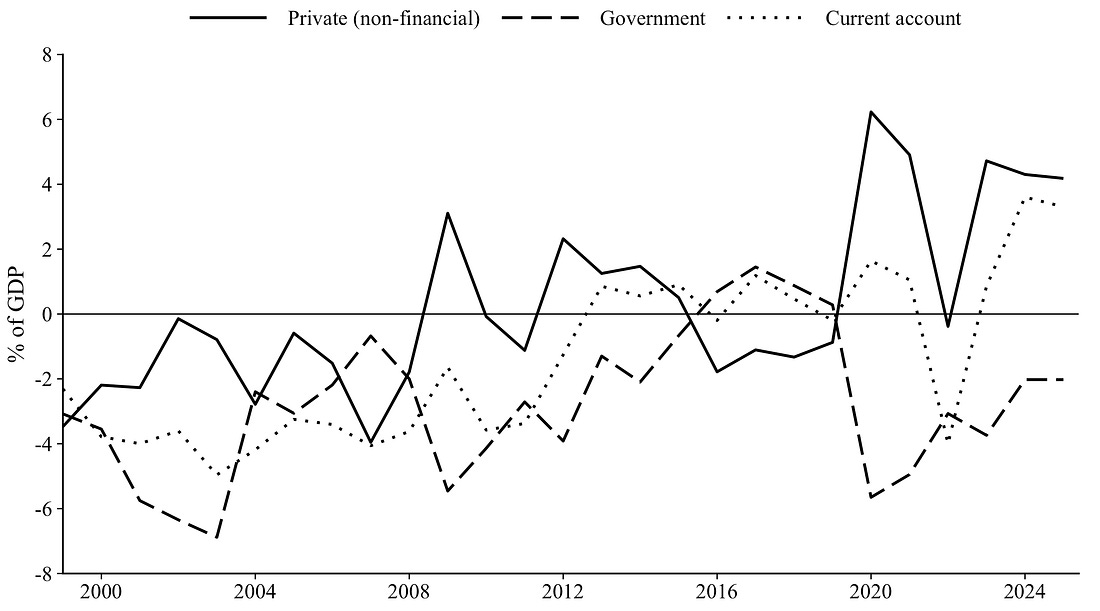
Until 2008 the non-financial private sector ran a deficit. After Covid it has run a surplus, mainly because households were saving, while firms were still borrowing. Because Czechia is a small export-oriented economy, the external account has to be split into the trade balance, primary income, and the current account.
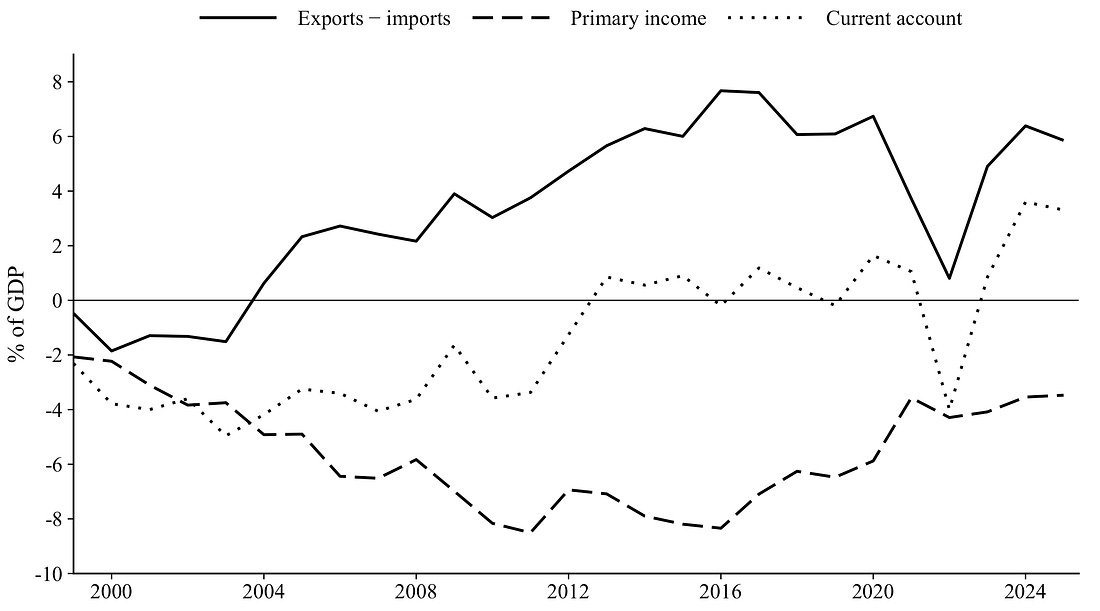
The trade surplus has gone with an outflow of primary income to foreign owners. Godley’s trade ratio is 109, the current-account ratio is 102, close to balance. Figure 4 plots GDP against both combined ratios, indexed to 2004.
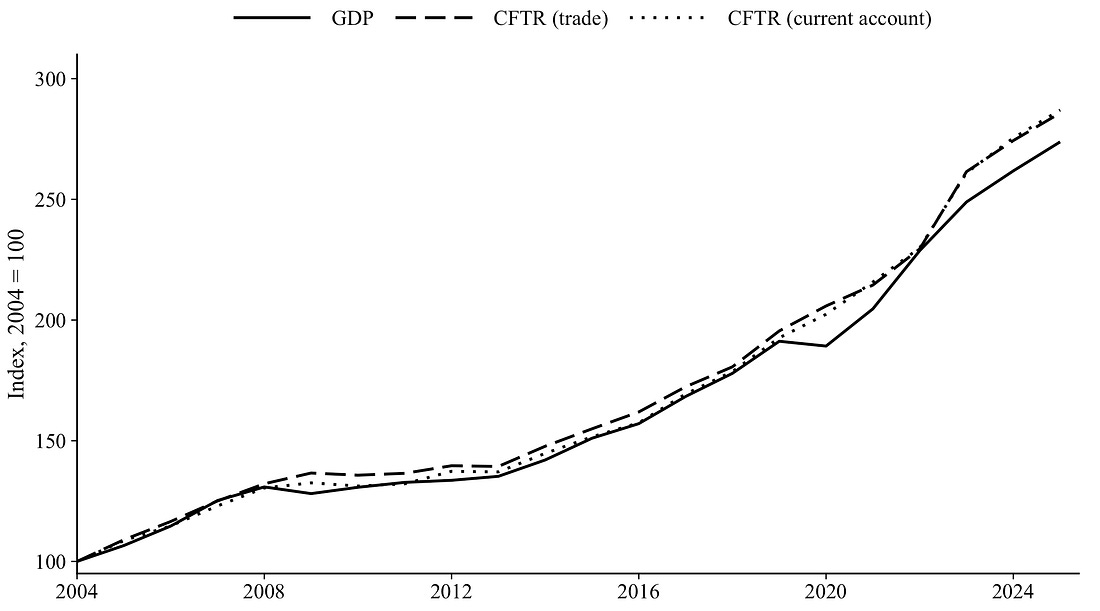
Even a cursory visual glance suggests that the three lines are strongly correlated. The correlation of the annual pace of GDP with the trade \(\mathit{CFTR}\) is 0.65 for the period, and 0.69 with the current-account \(\mathit{CFTR}\). Simply put: Czech GDP was driven by fiscal injections and exports. The conventional view would of course be that this is nothing new in the world, but it is precisely the sectoral and accounting-consistent view that gives it not only a new motto, it is also a feed into the current omnipresent discussion about government debt. Does it mean something?
All models are wrong, but some are useful
Obviously, such a simple exercise might tell us nothing at all, but it is heterodox economics that has kept accounting consistency and real-world observation as the ultimate engine of the modelling approach. Wynne Godley set out his most famous and most cited framework with Marc Lavoie (2007), where the accounting consistency is explored in greater detail, and there is no shortage of SFC models in the literature since then.
III. Simple Forecasts.
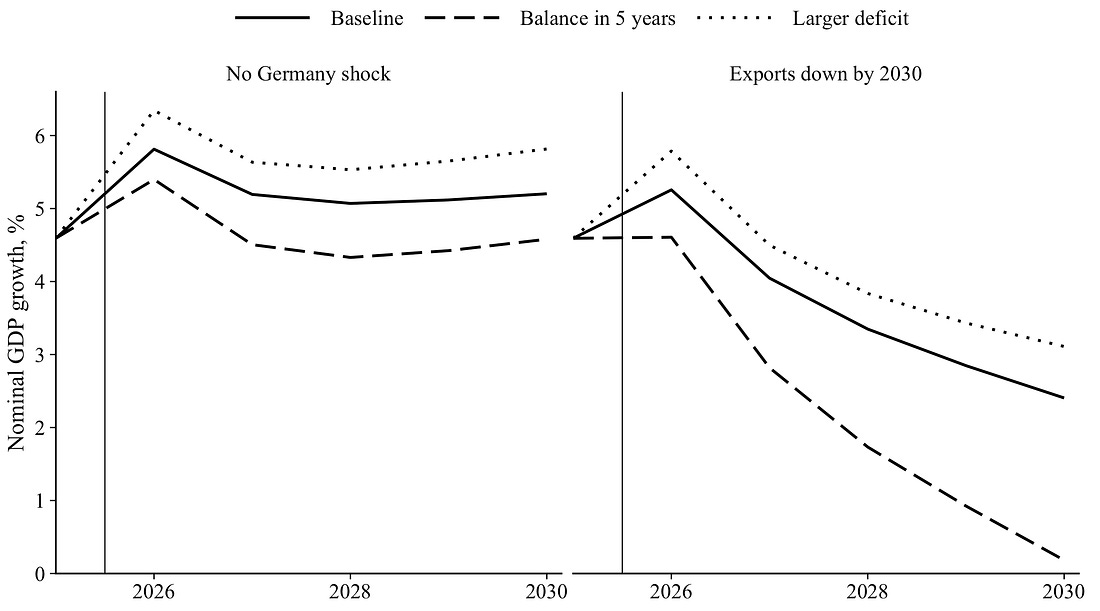
Now let us run some simple forecasts on the Czech data. We keep the same \(\mathit{CFTR}\) and let GDP follow it. The tax rate, import propensity, \(G\) and \(X\) are projected with a simple autoregression. I test three fiscal regimes, all applied to the next 5 years. First, keeping the budget as it is now. Second, balance it. Third, raising the deficit to 4.5 per cent of GDP. Finally, I repeat all three scenarios with a potential German demand shock, assuming that by 2030 total exports are lower by four percentage points of today’s GDP.
Without the shock, the first scenario’s nominal growth stays around 5.3% and debt around 48% of GDP. Balancing the budget costs about 0.6 points of growth a year and brings debt to 42%. A larger deficit gives 5.8% growth, but debt rises to 53% and the current account falls to minus 4%.
With the German shock, baseline growth averages 3.6% and falls to 2.4% by 2030. The deficit reaches 6%, and debt 60%. Balancing the budget brings growth in 2030 close to zero. Keeping the higher spending gives 4.1% average growth, but the deficit reaches 8%, the current account falls to minus 8.7%, and debt reaches 65%.
It is obvious that Czech households will not simply replace German demand with higher spending (unless we consider some unrealistic scenarios, e.g. a boom in which they sell the assets and spend the proceeds). They will keep saving. The identity leaves two options, either weaker GDP or a larger public deficit. You cannot have the same growth as before without one of them, per his majesty, Wynne Godley.
IV. Some outcomes.
Reconciling the GDP (demand-driven) identity with flows is a simple exercise, yet it gives some food for thought. Czech GDP is driven by effective demand and exports, as was reported by numerous studies and official statistics, and there is absolutely no new finding here. Any reliable model or specification will require a complex and non-linear analysis, and the question here is not whether the fiscal position is important or decisive for economic growth. That is a normative dispute, typical of post-communist countries, and in some sense of radical economic schools (MMT-ers, neo-Marxians v. Austrians, etc.). The idea here was to take a look from technocratic post-Keynesian positions, almost absent in the current mainstream discourse.
A few topics worth exploration are the deeper relationships in money flows between the sectors. As we have seen in Figure 1, a central government positive net financial position withdraws net assets from the private sector, but it also changes the composition of the money supply. A persistent surplus would mean less government money in the money supply (measured by M3), meaning that the most probable next step would be accelerated bank money creation (where else would the households and firms go?). Extending government deficit, as we can see, is (not)constrained by a heated political debate and some paperwork in Parliament, while the higher rate of new loans creation is constrained, at the very least and to a certain extent, by some Basel IV requirements (output floor, leverage ratio, capital adequacy ratio, provisions, IRB model methodology, etc.), internal risk assessments, and of course, the monetary policy. Not to mention the (already high) cyclicality, systemic risks, and the nexus risks resulting from the change in the composition of banks’ balance sheets.
In that sense, the ultimate set of questions for future research is: how will the sectoral balance sheets look under different regimes? I am keen to find out.
References
- Backus, D., Brainard, W. C., Smith, G., & Tobin, J. (1980). A model of U.S. financial and nonfinancial economic behavior. Journal of Money, Credit and Banking, 12(2), 259–293. https://doi.org/10.2307/1992063
- Copeland, M. A. (1952). A study of moneyflows in the United States. National Bureau of Economic Research.
- Godley, W. (1999). Seven unsustainable processes: Medium-term prospects and policies for the United States and the world (Strategic Analysis). Levy Economics Institute of Bard College. Available online at: https://www.levyinstitute.org/pubs/sr/sevenproc.pdf
- Godley, W., & Cripps, F. (1983). Macroeconomics. Fontana/Oxford University Press.
- Godley, W., & Lavoie, M. (2007). Monetary economics: An integrated approach to credit, money, income, production and wealth. Palgrave Macmillan.
- Leontief, W. (1966). Input-output economics. Oxford University Press.
- 1Obviously, private debt can accelerate with government running surplus as well, but we consider a strict accounting identity, not the mandatory 1:2 ratio. ↩